Selected as a “Treasure of the Expo”! MatriQ’s Full-Stack Neutral-Atom Quantum System Debuts at the Digital Trade Expo.
From September 23 to 27, the Fifth Global Digital Trade Expo (the “Expo”) was held at the Hangzhou Grand Convention and Exhibition Center.Hangzhou MatriQ Computing Co., Ltd. (“MatriQ”) exhibited at the Expo for the first time; its self-developed “full-stack integrated large-scale neutral-atom quantum computer” was selected as one of the Expo’s “Treasures of the Show”, achieving the construction and stable operation of a defect-free array of up to 2,310 physical qubits, and the “MatriQ Quantum Cloud Platform” was publicly unveiled for the first time.
Under the annual theme “Meet the AI Future at the Digital Trade Expo”, this year’s event put a spotlight on artificial intelligence, with 226 debuts, first shows and first exhibitions that fully presented the new momentum of digital trade in the AI era. Premier Li Qiang attended the opening ceremony and delivered a speech. The Expo covered an exhibition area of 170,000 square meters and brought together more than 2,000 exhibitors, with over 50,000 professional buyers from 163 countries and regions registered to attend. A Token-themed AI Future Zone was set up for the first time, organized along the full industry-chain logic of “computing foundation, model services and application scenarios”, in which quantum computing and AI chips together form the key exhibits of the computing foundation. On the morning of September 24, Andy Xia, Founder and CEO of MatriQ, attended the opening ceremony of the Expo.

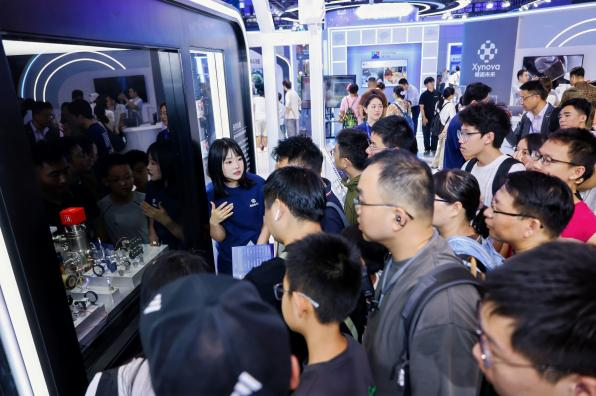
MatriQ’s booth at the Global Digital Trade Expo
01
Neutral-Atom Quantum Computer
Showcased Independently as a New Computing Foundation
In the theme pavilion of this year’s Expo, MatriQ unveiled China’s first full-stack integrated large-scale neutral-atom quantum computer.
The machine integrates core modules — vacuum, optics, measurement and control, and thermal management — into a single unit, and is designed for long-term stable operation, full-lifecycle maintenance and iteration, and commercial on-site deployment. According to MatriQ, the system delivers a computing speed more than a thousand times that of conventional computers, and can complete complex computational tasks in frontier scenarios such as materials mechanism research, protein structure analysis and new drug screening.
In terms of technical architecture, the machine adopts a “memory–entanglement” zoning architecture: the memory zone is responsible for maintaining the coherence of the qubit array, while the entanglement zone handles two-qubit gate operations, with movable optical tweezers used to schedule atom arrays across functional zones. This design effectively isolates the memory qubits from the entanglement operation area, reduces the errors introduced by off-target illumination and gate operations, and provides underlying architectural support for the implementation of future quantum error correction schemes. On core metrics, the system is based on rubidium-87 atoms, with global single-qubit gate fidelity above 99.9%, two-qubit gate fidelity in the entanglement zone above 99.2% and SPAM fidelity above 99.7%. From the 300-physical-qubit prototype V1 in 2024, to the 1,000-qubit defect-free array in 2025, and to surpassing 2,310 qubits in the first half of 2026, MatriQ’s R&D focus has shifted from scaling up the array to improving system stability and maintainability.
02
MatriQ Quantum Cloud Platform Makes Its Public Debut
Quantum Computing Power, Available Online
Unveiled alongside the machine, the MatriQ Quantum Cloud Platform takes MatriQ’s self-developed neutral-atom quantum computer as its core computing foundation, providing convenient and open online quantum computing services to research institutions, developers and industry users. The platform offers unified access to MatriQ’s own real-machine QPUs. At this stage it focuses on serving scientific research, algorithm development and early-stage scenario validation, lowering the barrier for external teams to work with neutral-atom quantum computers.
Users submit quantum programs through standardized programming interfaces, and the platform automatically handles compilation and optimization, resource scheduling and task execution — with no need to concern themselves with the details of the underlying quantum hardware. The platform provides complete and traceable experimental data and results, offering trustworthy support for research reproduction and validation. It currently supports applications such as quantum algorithm research and quantum simulation, while advancing ecosystem partnerships in parallel. Through the MatriQ Quantum Cloud Platform, hardware and the cloud reinforce each other — a key step for MatriQ from delivering machines to delivering computing power as a service.
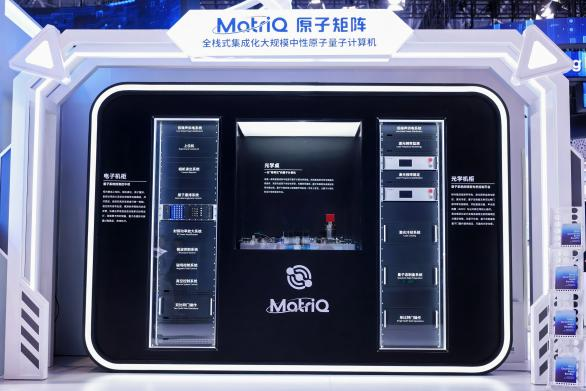
MatriQ Quantum Cloud Platform
03
Three Advantages of the Neutral-Atom Route
Quantum and Conventional Computing Complement Each Other
On the day of the opening ceremony, Andy Xia, Founder and CEO of MatriQ, was invited to the “Digital Economy and Artificial Intelligence Dialogue”, where he shared his views on the technical route, industrial value and application prospects of neutral-atom quantum computing.
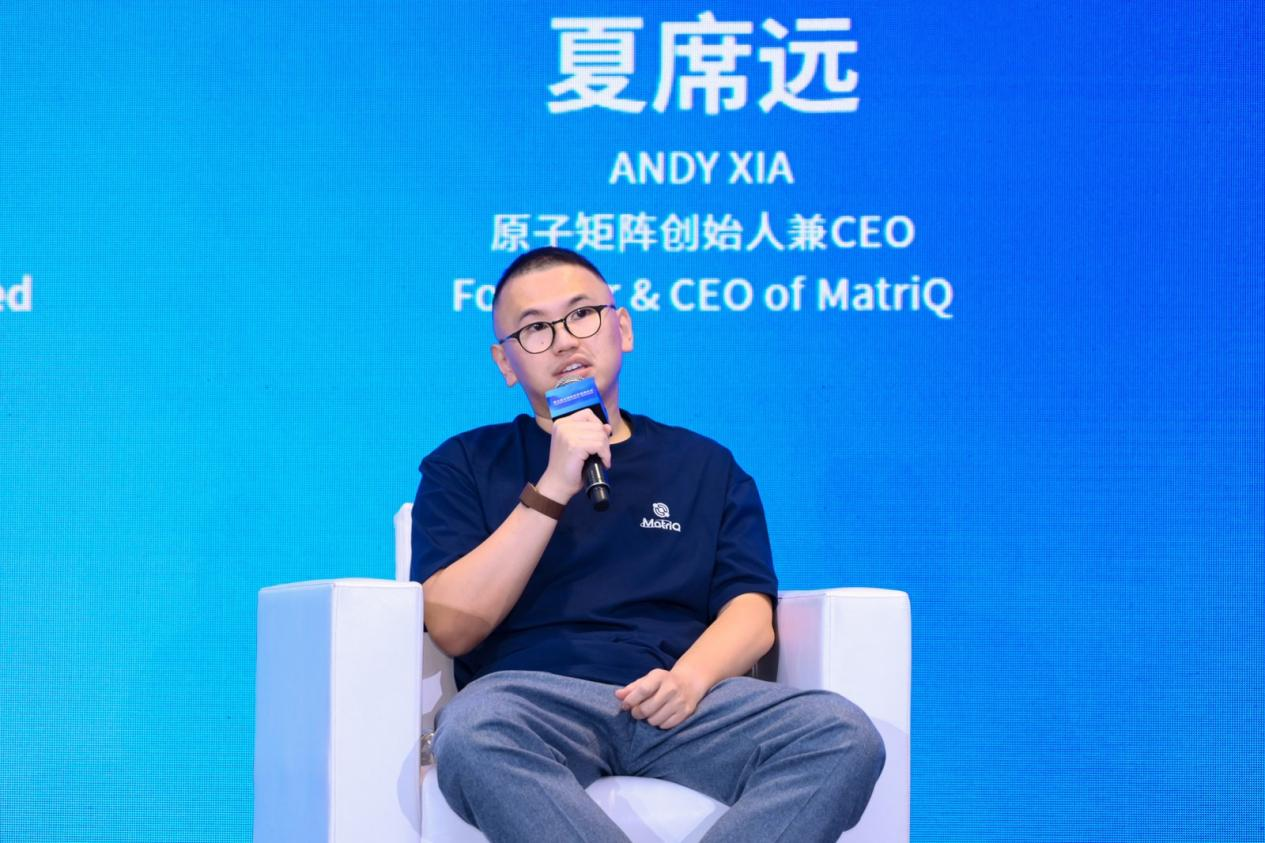
Andy Xia, Founder and CEO of MatriQ, at the “Digital Economy and Artificial Intelligence Dialogue”
Xia introduced that MatriQ was founded in 2025 and focuses on neutral-atom quantum computing, with a core team from world-renowned research institutions such as the Max Planck Institute, Imperial College London and the University of Cambridge, and more than a decade of accumulated expertise in the field of neutral-atom technology. The company’s business extends from underlying machine hardware to middleware software and the upper-layer application ecosystem. He noted that the neutral-atom route has drawn widespread attention in recent years for three main reasons: first, its strong scalability — qubits are added by increasing laser power, which helps improve qubit scale and cost-effectiveness; second, atoms are naturally identical, so there is no yield problem as with semiconductor chips; third, the route relies mainly on optical components, and China has a solid optical industry supply chain.
Speaking of the relationship between quantum processing units (QPUs) and CPUs and GPUs, Xia believes that QPUs will not replace CPUs and GPUs, but will complement them. Quantum computing power is expected to play a role in problems that conventional computing struggles to solve efficiently, and materials R&D, new drug development and optimization problems may become the application areas where real value emerges first.
04
From Booth Buzz to Industrial Deployment:
Quantum Computing Power Accelerates Across Industries
At the Expo, MatriQ also set up three quantum interactive mini-games, turning quantum gate operations, Rydberg blockade and problem mapping into hands-on experiences that help general visitors intuitively understand the basic principles of neutral-atom quantum computing. During the Expo, visitors to the MatriQ booth ranged from the general public to developers and industry players, each with different concerns: the public asked when quantum computing would become usable, developers asked when they could access the MatriQ Quantum Cloud Platform, and industry players asked what specific problems quantum computing power could solve. Multiple media outlets came to interview and film, and relevant government departments and industry clients also visited the booth to learn about the delivery progress and future plans of MatriQ’s self-developed machine and cloud platform.

MatriQ’s quantum game zone, where visitors can try quantum computing hands-on
From machine delivery to cloud services, what MatriQ showcased at this year’s Expo is not just a quantum computer, but an industrialization path toward the next-generation computing architecture. In September this year, the Ministry of Industry and Information Technology and the National Development and Reform Commission issued the “15th Five-Year Plan for the Development of the Electronic Information Manufacturing Industry”, which explicitly calls for accelerating the layout of new computing paradigms such as quantum computing. Against the backdrop of ever-rising AI computing demand, MatriQ is taking the neutral-atom quantum computing route as its fulcrum, full-chain in-house R&D as its moat, and machine delivery plus cloud services as its twin engines, to drive quantum computing power from the laboratory into real-world applications.


MatriQ and BGI-Research Sign Strategic Partnership to Advance Quantum Computing for Life Sciences
2026/10/23

MatriQ Secures Exclusive Strategic Investment from Fortune Capital to Accelerate Commercialization of Neutral-Atom Quantum Computing
2026/10/16

Meet the AI Future at the Digital Trade Expo | MatriQ Invites You to the 5th Global Digital Trade Expo
2026/09/20