MatriQ Secures Exclusive Strategic Investment from Fortune Capital to Accelerate Commercialization of Neutral-Atom Quantum Computing
Recently, Hangzhou MatriQ Computing Co., Ltd. (“MatriQ”) announced that it has secured an exclusive strategic investment from Fortune Capital, with this round jointly funded by the Hunan Jinfurong Fortune Future Industry Fund and the Shanghai Guochen Fund. The proceeds will be focused on independent R&D of core modules, engineering implementation of the complete quantum computer, development of the MatriQ Quantum Cloud Platform and expansion of the high-end talent team, comprehensively advancing the company’s industrialization.
A 2,310-Qubit Defect-Free Array: One of the Few Companies in China Capable of Delivering Kilo-Scale Neutral-Atom Quantum Computers
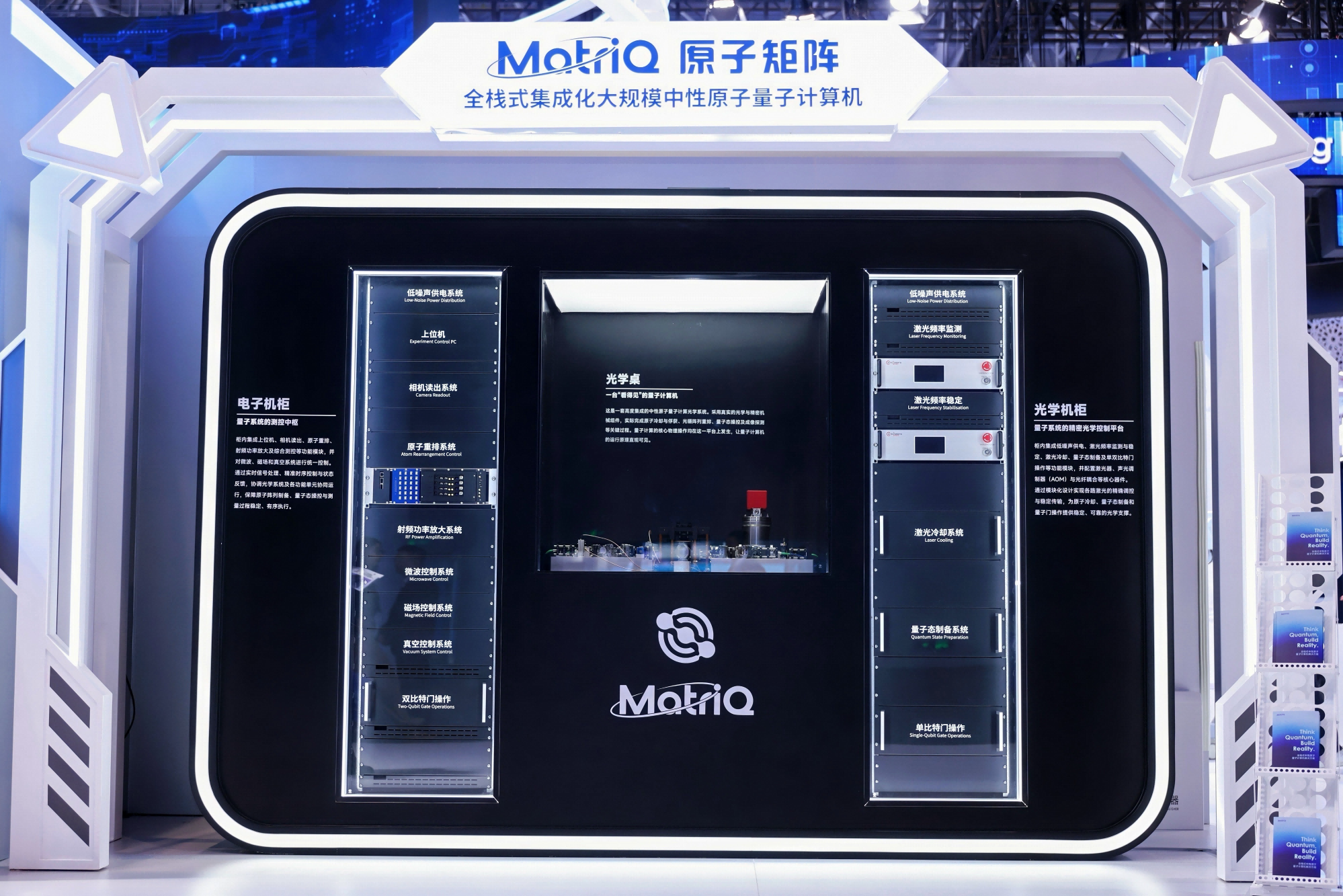
Core R&D team members of MatriQ all come from world-leading research institutions such as the Max Planck Institutes, Imperial College London and the University of Cambridge. Since its founding, the team has focused on the R&D of complete neutral-atom quantum computing systems, building a full technology chain that runs from in-house development of core components to full-stack system integration. The company has so far achieved stable operation of a defect-free atom array of up to 2,310 qubits, making it one of the few enterprises in China with the capability to deliver neutral-atom quantum computers at the kilo-qubit level and above. It has also secured its first commercial orders for complete systems, marking the leap of its technological achievements into commercial deployment.
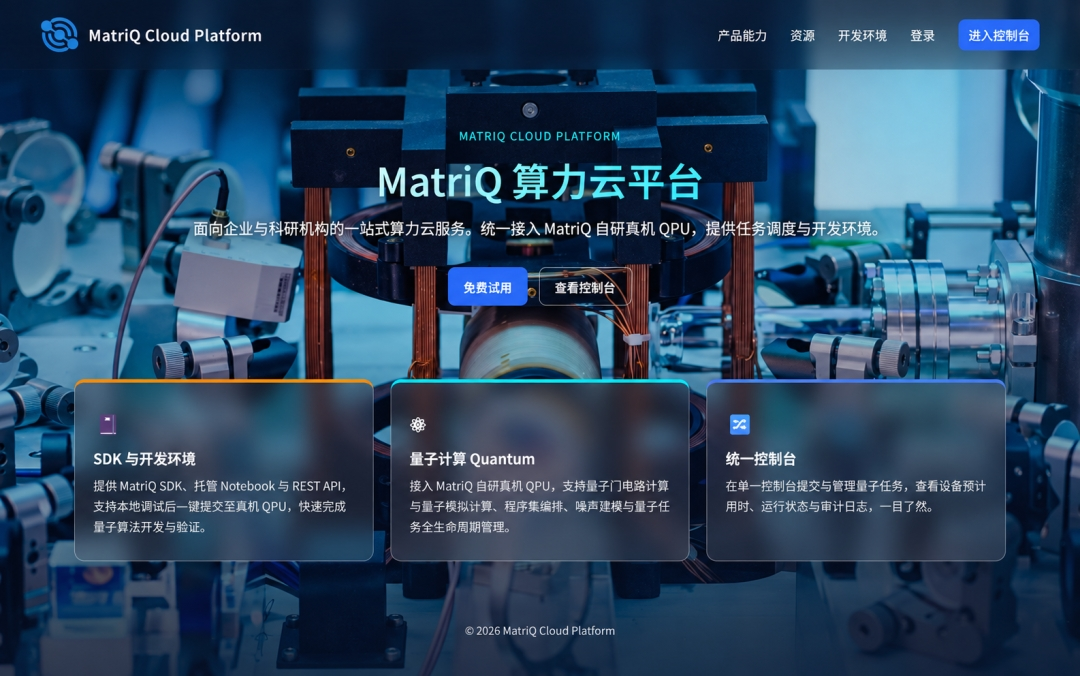
Beyond hardware, MatriQ is also building the MatriQ Quantum Cloud Platform, opening up the computing power of its self-developed quantum machines to research institutions and industry customers through cloud services. The platform connects directly to MatriQ’s own quantum processors and comes with standardized programming interfaces, intelligent task scheduling and full-chain traceability of results, so users can submit quantum computing tasks online and obtain results from the real machine directly. At this stage the platform mainly serves scientific research and validation of frontier applications, and will gradually expand to more industrial deployment scenarios.
Quantum Computing Becomes a Priority in Future-Industry Planning Across Regions; the Neutral-Atom Route Enters Its Industrialization Window
Quantum computing has been included in the national list of key future industries. As a core component of next-generation computing infrastructure, it has also become a frontier track that local governments are prioritizing. Among the available approaches, neutral-atom quantum computing — with its outstanding scalability, long coherence times, superior full connectivity of qubits and no need for ultra-low-temperature operating environments — is widely regarded by the industry as one of the general-purpose quantum computing routes most likely to achieve large-scale deployment.
Quantum computing is a long-cycle deep-tech track that relies heavily on patient capital with a long-term perspective. Fortune Capital has long been deeply engaged in the deep-tech field, and its investment logic is highly consistent with the development pattern of the quantum computing industry. MatriQ is now at a critical inflection point as it moves from technology R&D toward large-scale system delivery. This strategic investment, completed through the Hunan Jinfurong Fortune Future Industry Fund and the Shanghai Guochen Fund managed by Fortune Capital, is both a strong endorsement by local industrial capital of MatriQ’s engineering capability in neutral-atom quantum computers, and a signal that the neutral-atom quantum computing track has formally entered a new stage in which capital and local governments work together to empower and invest in the sector.
Ren Junzhao, Partner at Fortune Capital, said: “We have been following the neutral-atom route for a long time. This year, several key signals emerged at once: the supporting capability of the domestic supply chain can now meet the needs of engineering-grade complete systems, and what MatriQ has delivered is not a paper or simulation data, but a machine that runs on site and can be verified by third parties. Together, these signals mean that a systemic investment window has opened. Leading this round at this point is not a bet on a technology direction, but a judgment that the industrialization inflection point is happening right now. From scaling up the array and validating the zoning architecture to the public debut of the complete system, MatriQ has formed relatively clear R&D results at each stage, and the team has maintained a steady pace of progress. We look forward to MatriQ gradually improving its system software, development interfaces and task management on the basis of solid hardware R&D, and connecting with more research and industry partners.”

MatriQ and BGI-Research Sign Strategic Partnership to Advance Quantum Computing for Life Sciences
2026/10/23

Selected as a “Treasure of the Expo”! MatriQ’s Full-Stack Neutral-Atom Quantum System Debuts at the Digital Trade Expo.
2026/09/29

Meet the AI Future at the Digital Trade Expo | MatriQ Invites You to the 5th Global Digital Trade Expo
2026/09/20